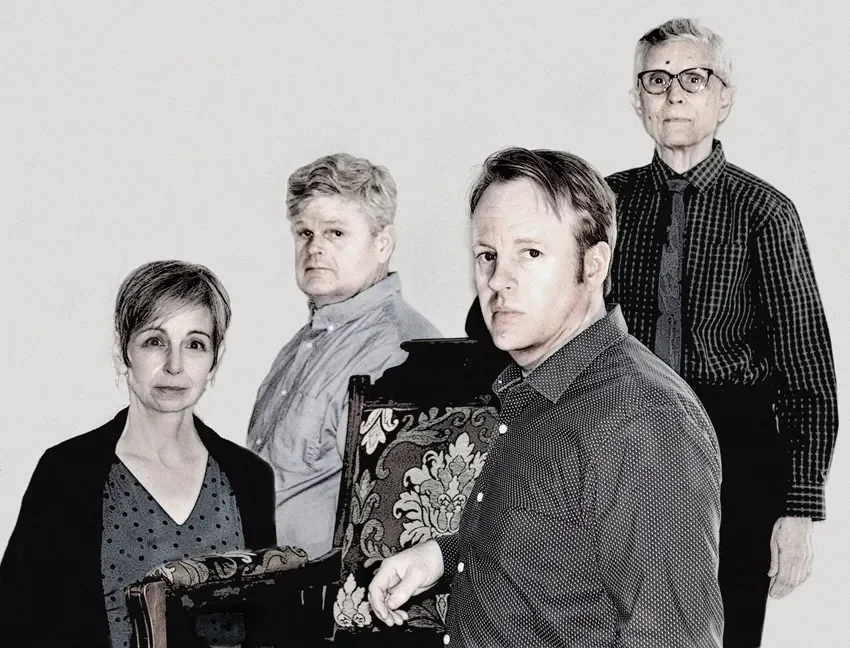
RedBird Theater Company's Production of The Price Is Intimate and Finely Wrought
This article was published by Triangle Review on April 22, 2026.
.
RedBird Theater Company's intimate, finely wrought production of The Price by Arthur Miller proves that great drama does not require spectacle -- only space, skill, and emotional truth. Under the direction of Derrick Ivey, this staging strips Miller's already spare play down to its emotional bones, allowing its questions about sacrifice, identity, and the weight of the past to resonate with striking clarity.
Having seen the production at the Jerry M. Passmore Senior Center in Hillsboorough, I can attest that the intimacy of the setting is not just effective -- it is transformative. With an audience of roughly 30 people seated only feet from the actors, there was no barrier between performer and observer. Every glance, every hesitation, every flicker of resentment or regret lands with amplified force. It felt less like watching a play and more like eavesdropping on a private reckoning, decades in the making.
The setting -- an attic in a soon-to-be-demolished brownstone in 1968 New York -- is beautifully realized. The stage, designed by JJ Bauer, is cluttered with the remnants of a life once lived: a leather chaise, a phonograph, a harp, and hulking wooden furniture from the 1920s or earlier. These objects are not merely props; they are silent witnesses to the Franz family's history, embodying the emotional and financial "price" at the center of the play. Each piece feels laden with memory, reinforcing Miller's notion that the past is not past at all, but an ever-present force shaping the present.
At the heart of the story is Victor Franz, portrayed with astonishing depth by Adam Sampieri. Victor, a policeman who sacrificed his education to support his father during the Great Depression, returns decades later to sell the family's belongings. Sampieri's performance is nothing short of extraordinary. He captures Victor's moral rigidity, his simmering resentment, and his deep exhaustion with life's disappointments. His portrayal evolves seamlessly from steadfast sincerity to quiet despair, culminating in an emotional unraveling that is both devastating and deeply human. By the end of the play, his anguish is so palpable that it lingers long after the final line -- I found myself in tears on the drive home.
Opposite Sampieri, Dale Wolf delivers a standout performance as Gregory Solomon, the elderly furniture dealer tasked with appraising the family's possessions. Wolf brings a vibrant, almost mischievous energy to the role, offering much-needed comic relief without undermining the play's gravity. His Solomon is quick-witted, persistently talkative, and surprisingly wise -- a man who seems to have lived many lives and learned from them all. His New York Jewish accent is so natural and well-executed that it feels unperformed, and his presence injects warmth and humanity into an otherwise tense and somber narrative.
Tamara Kissane'sEsther Franz is a more complex and occasionally uneven portrayal. Kissane, an accomplished playwright in her own right, leans into Esther's dual nature: at times fiercely supportive, at others deeply frustrated and resentful of Victor's inability to provide the life that she desires. This volatility can verge on melodrama, and her smile occasionally feels forced, but these choices also underscore Esther's desperation and dissatisfaction. Kissane's performance highlights the emotional cost of Victor's long-ago decision -- a reminder that sacrifice rarely affects only one person.
Carl Martin, making his debut with RedBird Theater Company, portrays Walter Franz with cool detachment and quiet intensity. Walter, once successful but now recovering from personal and professional collapse, serves as both foil and mirror to Victor. Martin captures Walter's intellectual confidence and emotional distance, while still revealing glimpses of genuine concern for his brother. His delivery of some of Miller's most incisive lines -- "We invent ourselves, Vic, to wipe out what we know," and "You get to think that because you can frighten people they love you" -- lands with precision and weight.
The ensemble's accents are uniformly excellent, so natural that one might momentarily forget these are actors from the Triangle rather than lifelong New Yorkers. This authenticity enhances the immersive quality of the production, grounding the performances in a believable world.
What makes The Price endure is its exploration of universal dilemmas: the tension between duty and desire, the burden of family expectations, and the elusive nature of meaning. As Victor himself admits, "It's impossible to know what's important." Miller's characters are trapped by economic determinism and societal pressures, yet they remain achingly human in their attempts to make sense of their lives.
This production honors Miller's vision that The Price is about "the power of the past" and the ways in which we construct narratives to survive it. Whether performed on April 9-12 at The ArtsCenter of Carrboro, on April 17th and 18th at the Passmore Center in Hillsborough, on April 25th and 26th at the Shadowbox Studio in Durham, or on May 2nd at The Ox Theater - City Hall Auditorium in Oxford, RedBird Theater Company's staging of The Price is a testament to the enduring relevance of Arthur Miller's work -- and to the power of intimate theater to move, unsettle, and ultimately transform its audience.