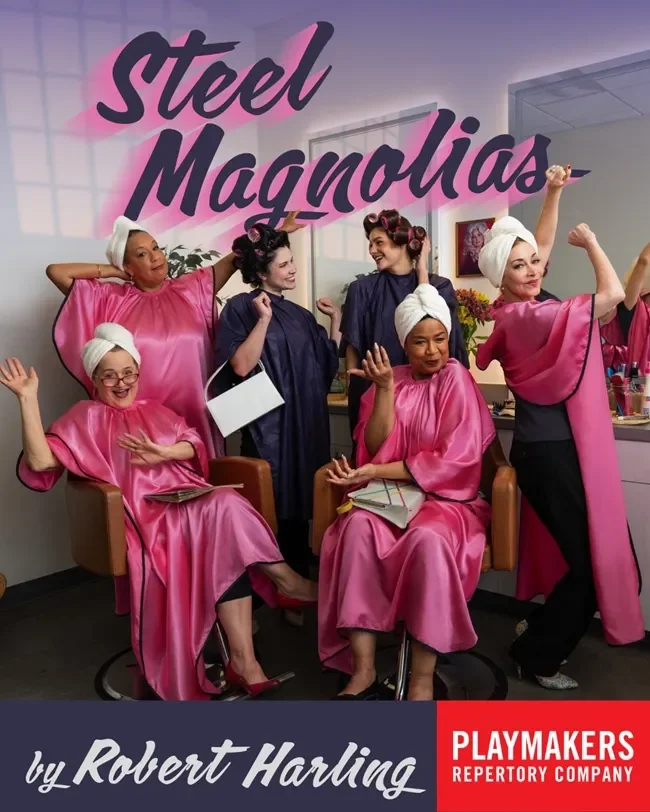
Steel Magnolias Is a Beloved Classic, But the Script Feels Surprisingly Hollow
This article was published by Triangle Review on April 16, 2026.
Steel Magnolias is a beloved American classic that, in this particular outing at PlayMakers Repertory Company, reveals just how thin its emotional scaffolding can be. Directed by Lisa Rothe and closing out the company's season on the UNC-Chapel Hill campus, this production boasts a strong cast and polished design -- but ultimately struggles to elevate a script that feels surprisingly hollow.
Written by Robert Harling as a tribute to his sister, who died in 1985, Steel Magnolias has enjoyed extraordinary success since its 1987 debut: a long Off-Broadway run, a national tour, a popular 1989 film adaptation, and even a Broadway revival. Harling famously wrote the play in just 10 days -- a detail that feels less like a charming anecdote and more like a key to understanding its limitations. Despite its reputation as a heartfelt exploration of female friendship, the play often leans heavily on surface-level conversation, rather than meaningful emotional excavation.
Set entirely in Truvy Jones' hair salon, the play follows a group of Southern women whose lives intersect through appointments, gossip, and shared hardships. In theory, the material is rich: marriage, illness, pregnancy, and grief all make appearances. In practice, however, much of the dialogue amounts to shallow chit-chat that rarely deepens our understanding of the characters. The women are positioned as intimate allies rather than adversaries -- a refreshing contrast to many female-driven narratives -- but their bonds are told to us more than they are convincingly dramatized.
This creates a particular challenge for the performers. With characters that feel underwritten, actors must walk a fine line: push too hard for emotional depth, and the performance risks tipping into melodrama; hold back, and the already thin material becomes inert. To their credit, this cast consistently finds ways to navigate that tension.
Standout among them is Julia Gibson as the irascible Ouiser Boudreaux. Gibson injects a welcome sharpness into the production, delivering biting humor while grounding her character in flashes of genuine feeling. Her performance provides much-needed texture, and her comic timing consistently energizes the stage.
Another highlight is Caroline Marques as Annelle Dupuy-Desoto. Marques brings a gentle, wide-eyed sincerity to the role, capturing both the character's awkward innocence and her later, fervent religious conviction. Her performance is endearing without becoming caricature, and her arc is one of the few that feels emotionally coherent. There's a touch of the same quirky optimism found in Waitress' Dawn -- a comparison that underscores Marques' ability to bring earnestness to her portrayal.
Elizabeth Dye offers a steady portrayal of Shelby Eatenton-Latcherie, while guest artist Thursday Farrar (making her PlayMakers debut) brings warmth to Clairee Belcher. Longtime PlayMakers company member Kathryn Hunter-Williams as Truvy and Sharon Lawrence as M'Lynn Eatenton -- herself a UNC-Chapel Hill alumna with a distinguished screen career, including NYPD Blue and Grey's Anatomy -- deliver polished, professional performances. Each actor does admirable work within the constraints of the script, even when the material gives them little to build on.
Where the production truly excels is in its design. Scenic designer Narelle Sissons has created an impressively expansive 1980s beauty salon that feels both authentic and theatrically functional. The set includes every expected detail -- wash stations, styling chairs, and a wonderfully oversized hooded dryer -- while maintaining clear sightlines that allow the audience to take in every moment of action. The space is immersive without being cluttered, and visually engaging from every angle.
Costume designer Grier Coleman further enhances the production's sense of time and place. The wardrobe leans fully into the bold, unmistakable aesthetic of the 1980s, providing both humor and authenticity. There's a nostalgic charm in these choices -- so specific that one might even recognize echoes of their own past wardrobe in Shelby's outfits.
Despite these strengths, the central issue remains the play itself. Steel Magnolias gestures toward profound emotional territory but rarely commits to exploring it in depth. The result is a production that feels curiously static: moments of humor and camaraderie are present, but the emotional stakes never fully land.
As the final production of PlayMakers' 2025-26 season, this staging showcases the company's reliable strengths -- talented performers, thoughtful direction, and high production values. Yet it also serves as a reminder that even the most skilled artists can only do so much with material that doesn't fully support them. Here, the magnolias may be steel by name; but, dramatically, they feel more fragile than formidable.