The Sound of Music at DPAC Is a Lavish, Heartfelt Revival of a Timeless Classic
This article was published by Triangle Review on 9 October 2025.
Few musicals hold as cherished a place in American hearts as The Sound of Music, the beloved Rodgers & Hammerstein classic that first graced Broadway in 1959. Now playing at the Durham Performing Arts Center(DPAC) through Sunday, Oct. 12th, this lavish 2025 touring production -- directed by three-time Tony Award® winner Jack O'Brien (Hairspray) -- reminds audiences why the story of Maria Rainer and the von Trapp family continues to enchant generation after generation.
Based on The Story of the Trapp Family Singers, a 1949 memoir by Maria von Trapp (1905-87), the musical chronicles the story of a young postulant sent from Nonnberg Abbey in Salzburg, Austria, to serve as governess to the seven children of widowed naval Captain Georg von Trapp (1880-1947). As Maria brings music and laughter back into their lives, she finds her own calling -- both as a mother and as a wife -- just as the family faces the growing threat of Nazi occupation.
In this production, Maria von Trapp is played by Cayleigh Capaldi, a performer with an impressive résumé that includes leading roles as Celine Dion and Rose in the Off-Broadway hit Titaníque and a West End stint earlier this year. Capaldi's crystalline soprano and fearless yodeling in "The Lonely Goatherd" earned well-deserved applause from Tuesday's opening-night crowd. Yet her portrayal of Maria leans, at times, too heavily on boundless energy. Maria's zest for life is central to the story, but Capaldi's near-manic exuberance occasionally crosses into unsettling territory, especially in scenes with the children, where a touch more nuance would deepen the warmth of her portrayal.
Broadway veteran Christiane Noll brings gravitas and vocal power to her role as the Mother Abbess. Her rendition of "Climb Ev'ry Mountain" fills the cavernous DPAC with an emotional transcendence that is almost spiritual. The ensemble of nuns surrounding her is equally superb -- their harmonies pristine, their timing precise, and their presence luminous, particularly during the wedding scene that closes Act II.
Kevin Earley delivers a marvelous Captain Georg von Trapp, capturing the full emotional arc of his character's transformation -- from stern disciplinarian to tender father and lover. Earley's duet with Capaldi in "Something Good" is tenderly understated, and his solo "Edelweiss" embodies both patriotism and loss.
Adding warmth and humor to the narrative are Nicholas Rodriguez as Max Detweiler and Kate Loprest as Elsa Schraeder. Rodriguez plays Max with a charming blend of cynicism and sincerity, and his easy rapport with Loprest gives their scenes a playful sophistication.
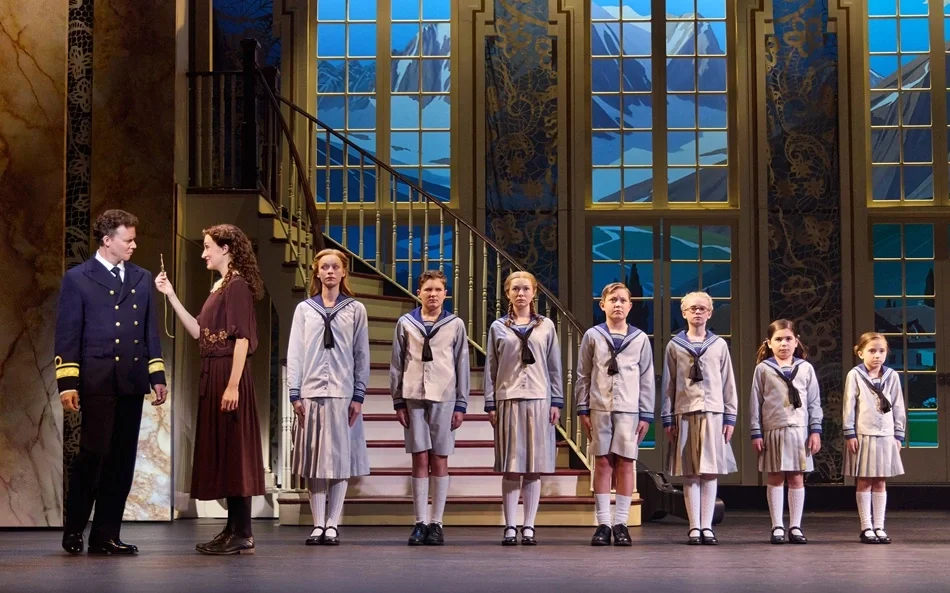
But it's the von Trapp children who steal the show. Ariana Ferch (Liesl); Eli Vander Griend (Friedrich); Ava Davis (Louisa); Oliver Cirelli (standing in for Benjamin Stasiek, as Kurt); Haddie Mac (Brigitta); Ruby Caramore (Marta); and Luciana VanDette (Gretl) -- all of these young actors and singers conjure the famously talented children that they are portraying. From their crisp choreography to their sweet, clear harmonies, the young performers bring authenticity and joy to every moment onstage. Haddie Mac's Brigitta, in particular, stands out -- her blatant observations and perfectly timed quips earn some of the biggest laughs of the night.
The technical and design elements of this production are nothing short of breathtaking. Douglas W. Schmidt's sets evoke a sense of grandeur and intimacy all at once. One moment, the audience gazes through floor-to-ceiling windows onto snow-capped Austrian mountains; the next, we're inside the shadowy, stained-glass-lit abbey. The fluid transitions and architectural detail make each scene feel like a glimpse inside an exquisitely crafted (and located) dollhouse.
Complementing the scenic magic are Jane Greenwood's historically faithful costumes -- flowing habits, crisp naval uniforms, and soft floral dresses -- that lend the production its timeless aesthetic. Natasha Katz'slighting design, subtle yet transformative, shifts seamlessly between the warmth of domestic scenes and the looming tension of political upheaval.
Meanwhile, Kai Harada's sound design ensures every note -- whether whispered or belted -- resonates clearly in DPAC's expansive auditorium. The technical precision of this show is a masterclass in theatrical craft.
Jack O'Brien's direction maintains a delicate balance between nostalgia and emotional truth. He resists the temptation to reinvent The Sound of Music for modern sensibilities, instead allowing the story's inherent sincerity and moral courage to shine through. The pacing is brisk but never rushed, and even the most familiar songs -- "Sixteen Going on Seventeen," "Do-Re-Mi," and "So Long, Farewell" -- feel fresh thanks to the cast's palpable connection and vocal excellence.
On opening night, the audience ranged from preschoolers to octogenarians, proving the show's enduring cross-generational appeal. This Sound of Music is more than a revival -- it's a reminder that joy, courage, and family perseveres even in the darkest times. It's well worth staying up past bedtime.
Verdict: The Sound of Music is a stunning, family-friendly revival that honors the heart of a classic while showcasing the best of current Broadway artistry.