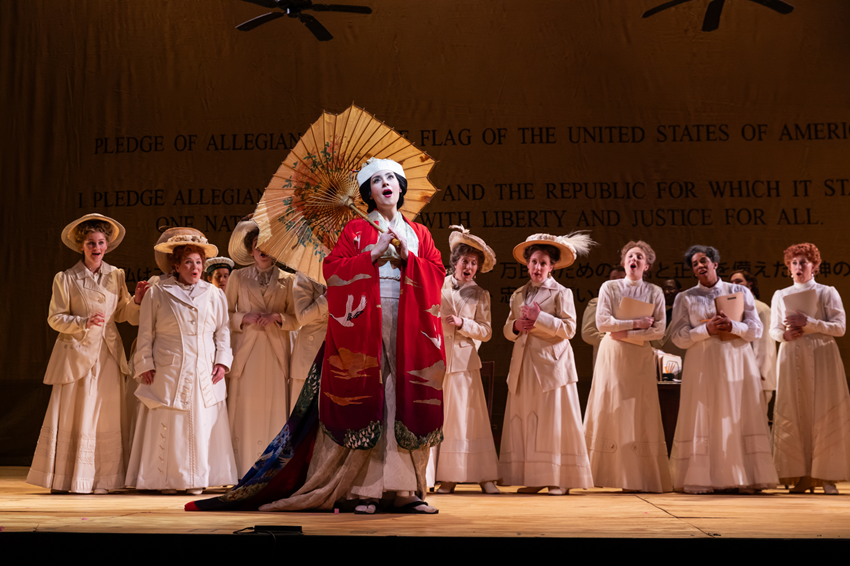
Caitlin Gotimer Is Incredible as Cio-Cio-San in the North Carolina Opera's Madama Butterfly
This article was published by Triangle Review on 29 January 2025.
You don't want to miss soprano Caitlin Gotimer's incredible manifestation of the tragic Cio-Cio-San in the North Carolina Opera's production of Giacomo Puccini'sMadama Butterfly, performed Jan. 30th and Feb. 1st in Raleigh Memorial Auditorium in the Martin Marietta Center for the Performing Arts in downtown Raleigh. It is North Carolina Opera's first production in 2026 and the first time that they have presented Puccini's famous tragedy in more than 10 years. Many of the principal singers are making their company debuts.
Madama Butterfly was inspired by the semi-autobiographical novel Madame Chrysanthème, written in 1887 by French naval officer and travel writer Pierre Loti. American writer John Luther Long published the short story "Madame Butterfly" in Century Magazine in 1898. American producer, director, and playwright David Belasco developed the story into a play -- Madame Butterfly: A Tragedy of Japan -- that premiered in New York City in 1900. And renowned Italian verismo composer Giacomo Puccini evolved the tale into the Japanese- and Italian-fused opera that endures today.
In Act I, set in 1904, a U.S. naval lieutenant named B.F. Pinkerton marries a 15-year-old Japanese girl named Cio-Cio-San (from the Japanese word for "butterfly") for convenience, intending to leave her -- thanks to the leniency of Japanese divorce laws -- once he finds a "proper" American wife. In devotion to her American husband, Cio-Cio-San converts from Buddhism to Christianity and is renounced by her family for doing so.
In Act II, Pinkerton leaves shortly after the wedding; and Cio-Cio-San, who has given birth to Pinkerton's son, waits faithfully for three long years for Pinkerton to return, despite everyone in her life insisting that he has abandoned her. In Act III, Pinkerton returns with his new American wife to claim his Japanese son, which devastates the heartbroken Cio-Cio-San, who kills herself in the final scene.
This year, North Carolina Opera'sMadama Butterfly is magnificently conducted by Arthur Fagen, who has been the music director of the Atlanta Opera since 2010, is professor of orchestral conducting at the Jacobs School of Music at Indiana University, and is in great demand as a conductor of symphony and opera in Europe, Asia, South America, and the United States.
The production is directed by Francesca Zambello, the internationally recognized director of opera and theater who directed North Carolina Opera's production of The Barber of Seville two years ago. In Madama Butterfly, Zambello blends both traditional Japanese life and American Military expatriatism with seamless and beautiful simplicity, turning her all-too-human subjects into scenery, shadow play, impressionist art, and back again.
Eric Taylor has a lovely tenor voice and is convincing in his role as B.F. Pinkerton. Efraín Solísprovides strong and harmonious support in his role as Sharpless, Pinkerton's Japanese consul. As Butterfly's maid Suzuki, Lisa Chavez is a captivating mezzo-soprano. All of theperformers are top-notch.
But, by far, the reason to go to this production is to witness soprano Caitlin Gotimer's superlative performance as the tragic Cio-Cio-San. I have never heard a human being sing like her in real life before. That she did so in the second and third acts for nearlytwo hours straight is almost unbelievable. And it's not just her voice that's worth experiencing. With seemingly little effort, Gotimer conjures the trusting, devoted, faithful, and naively tragic spirit of Cio-Cio-San, with a perfection that is rarely seen on stage. It is truly a privilege to see her perform.
Puccini's original version of the opera, in two acts and with an Italian libretto by Giuseppe Giacosa and Luigi Illica, premiered on 17 Feb. 1904 at La Scala in Milan and was poorly received, presumably due to inadequate time for rehearsals. Puccini split and expanded the second act in two, along with other changes, and the new production in Brescia on 28 May 1904 was a great success. This second version premiered in the United States in 1906 in Washington, DC. Puccini revised the opera three more times before finalizing what has become known as the "Standard Version" that is most often performed today.
At 3 hours (with a 20-minute intermission), sitting through the entire "Standard Version" is a feat that may make you wish that the original version had been preserved. But your patience is undeniably rewarded through Gotimer's impeccable acting and otherworldly vocals, as well as director Zambello's fluid, multilayered staging, which relies less on static sets than on carefully positioned, culturally costumed bodies to shape each scene.
Next up for the North Carolina Opera will be their annual Gala, featuring mezzo-soprano Taylor Raven, on Saturday, March 14th, at the Park Alumni Center of North Carolina State University. The North Carolina Opera's mainstage season concludes on April 17th and 19th, with Giuseppe Verdi'sIl Trovatore, featuring a cast of returning singers.
Even strong ticket sales cover only a fraction of what it costs to produce these operas, with the remainder being covered by grants and donations. It is a privilege and a gift for Triangle residents to be able to experience such high-caliber opera on their own turf. You don't want to miss the opportunity. Click here to donate to the North Carolina Opera.